Need Help Navigating VAT in Saudi Arabia 2026?
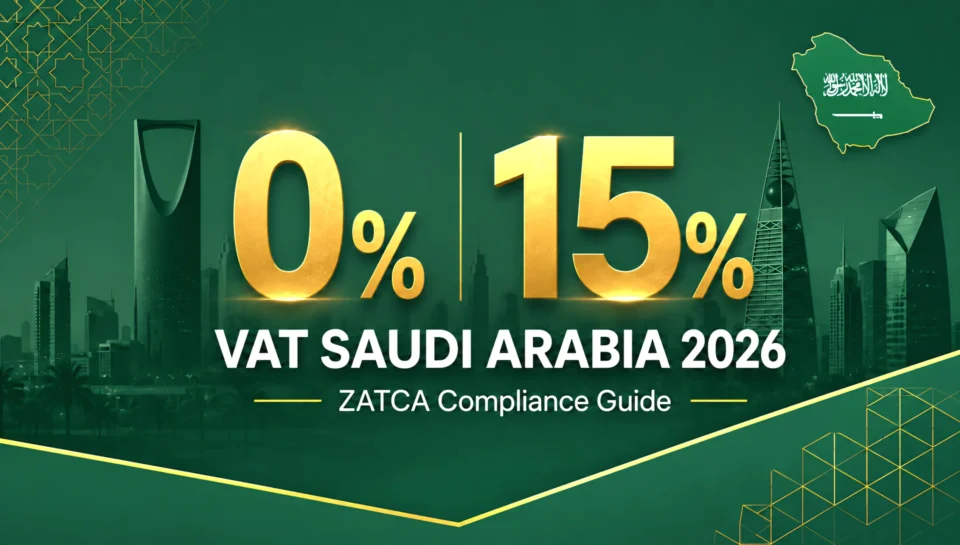
Value Added Tax, commonly known as VAT, remains one of the most important tax obligations for businesses operating in Saudi Arabia. VAT in Saudi Arabia 2026 is administered by the Zakat, Tax and Customs Authority (ZATCA), and applies to the import and supply of goods and services in the Kingdom, except where a specific zero-rated, exempt, or out-of-scope treatment applies.
Saudi Arabia implemented VAT from 1 January 2018 as part of the GCC VAT framework. ZATCA confirms that the VAT Law came into effect on 1 January 2018, and ZATCA’s VAT guidance explains that VAT is an indirect tax applied on the import and supply of goods and services at different stages of the supply chain, with certain exceptions.
For businesses navigating VAT in Saudi Arabia 2026, VAT compliance is no longer only about submitting a periodic VAT return. It now requires accurate VAT treatment, proper tax invoices, e-invoicing compliance, reconciliation with Fatoora data, timely filing and payment, strong supporting documentation, and readiness for ZATCA review or assessment.
Standard VAT Rate
Registration Threshold
Fatoora Deadline: June 30, 2026
Penalty Exemption Ends
Current VAT Rate in Saudi Arabia 2026
The standard VAT rate in Saudi Arabia 2026 is 15% where VAT applies. VAT-registered businesses must charge output VAT on taxable supplies and may recover eligible input VAT on taxable business purchases, subject to the VAT Law, Implementing Regulations, and ZATCA guidance.
ZATCA’s VAT amendment guideline states that VAT-registered persons must charge VAT at the standard rate of 15% where applicable, and separately account for output VAT collected on taxable sales. This Saudi Arabia VAT rate of 15% has been in effect since July 2020, when it was raised from the original 5% rate implemented in 2018.
For a complete understanding of how the Saudi VAT system works alongside ZATCA e-invoicing requirements, see our detailed ZATCA VAT Compliance Guide 2026 covering all 24 Fatoora waves.
VAT Registration Thresholds in Saudi Arabia 2026
Businesses should monitor VAT registration thresholds carefully. Understanding VAT in Saudi Arabia 2026 starts with knowing when your business must register.
Mandatory VAT Registration
VAT registration is mandatory if a person’s annual taxable supplies exceed SAR 375,000 within a 12-month period, or are expected to exceed this threshold in the next 12 months.
Voluntary VAT Registration
Voluntary registration is available for resident persons whose annual taxable supplies or taxable expenses exceed SAR 187,500 but do not exceed the mandatory threshold of SAR 375,000.
Recent VAT Updates Businesses Should Watch in 2026
1. Amendments to the VAT Implementing Regulations
ZATCA issued a guideline in April 2025 explaining amendments to the VAT Implementing Regulations under Board Resolution No. 01-06-24, dated 19 November 2024. These amendments significantly impact VAT compliance in Saudi Arabia 2026.
The guideline covers several practical areas including:
- VAT tax groups and continuous compliance requirements
- Cessation of economic activity procedures
- Deemed supplies treatment
- Transfer of economic activity rules
- VAT suspension provisions
- Services supplied to non-GCC residents
- Government subsidies treatment
- Financing contracts VAT treatment
- Input VAT deductions rules
- VAT return corrections procedures
- Refund offsets against other liabilities
- VAT refund procedures updates
Key Impact on VAT Tax Groups
One of the major updates relates to VAT tax groups. ZATCA clarified that all tax group conditions must be continuously met by every member throughout the period of registration. The amendments also restrict tax group membership for certain refund-eligible persons and persons licensed to operate in special economic zones with customs suspension status, except for limited cases specified in the regulations.
Existing tax groups were given a transition period of 180 days from publication in the Official Gazette to review and adjust their group structure. For group companies, this means VAT grouping should not be treated as a one-time registration exercise. Ownership, control, VAT refund eligibility, special zone status, and member activities should be reviewed periodically.
2. E-Invoicing Phase Two Continues in Waves
Saudi Arabia’s e-invoicing system, commonly known as Fatoora or Fatoorah, is now a core part of VAT in Saudi Arabia 2026. ZATCA explains that e-invoicing converts the issuing of paper invoices, credit notes, and debit notes into a structured electronic process through an integrated electronic solution.
E-Invoicing Phase Timeline
| Phase | Name | Effective Date | Requirement |
|---|---|---|---|
| Phase 1 | Generation Phase | 4 December 2021 | Electronic invoice generation |
| Phase 2 | Integration Phase | 1 January 2023 | ZATCA system integration (waves) |
| Wave 24 | SMEs Wave | 30 June 2026 | Businesses with revenue > SAR 375K |
This is especially important for small and medium businesses. E-invoicing integration is no longer only a large-company issue. Businesses should ensure that their ERP, POS, invoicing software, XML generation, QR code, credit notes, debit notes, simplified tax invoices, standard tax invoices, reporting, and clearance processes are aligned with ZATCA requirements.
3. VAT Return Filing Frequency and Payment Deadline
VAT filing frequency for VAT in Saudi Arabia 2026 depends mainly on the value of taxable supplies:
| Annual Taxable Supplies | Filing Frequency | Deadline |
|---|---|---|
| Above SAR 40 million | Monthly | Last day of following month |
| Below SAR 40 million | Quarterly (3-month period) | Last day of month after quarter end |
VAT returns must be filed no later than the last day of the month following the end of the tax period. Payment of tax due must also be made no later than the last day of the month following the end of the relevant tax period.
Example: A business filing a monthly VAT return for June should normally submit the return and pay the VAT due by the end of July. A business filing a quarterly VAT return should apply the same principle based on the end of the relevant quarter.
4. Penalty Exemption Initiative Extended to 31 December 2026
ZATCA announced that the Cancellation of Fines and Exemption of Financial Penalties Initiative has been extended for an additional six months starting from 1 July 2026 and ending on 31 December 2026. This is significant news for businesses managing VAT in Saudi Arabia 2026.
What the Initiative Covers
ZATCA’s simplified guide issued as of 1 July 2026 states that the initiative covers unpaid financial fines including:
- Late registration fines
- Delayed payment fines
- Overdue tax return submission fines
- VAT return correction penalties
Conditions for Eligibility
These conditions generally include:
- Registration with ZATCA where required
- Submission of all outstanding tax returns
- Payment of the principal tax debt, or applying for installment
- Complying with the approved installment plan until the end of the initiative period
What’s Excluded
However, the initiative does not mean all penalties are automatically removed. ZATCA’s guide identifies exclusions, including:
- Fines under Article 45 of the VAT Law
- Fines already paid before the initiative’s effective date
- Fines for returns due after 30 June 2026
- Tax evasion penalties
5. Electronic Marketplaces and the Deemed Supplier Rule
Starting from January 2026, amendments to Article 47(3) of the VAT Implementing Regulations regulate cases where an electronic marketplace facilitates the supply of goods or services in Saudi Arabia by one or more resident suppliers who are not VAT-registered. This is a major change affecting VAT in Saudi Arabia 2026 for digital businesses.
In such cases, the electronic marketplace may be treated as having purchased the goods or services from the non-registered resident supplier and then resupplied them to the final customer. As a result, the electronic marketplace may become responsible for collecting and remitting VAT on taxable supplies made through the platform.
This update is highly relevant for:
- Digital platforms
- Online marketplaces
- Delivery platforms
- Booking platforms
- Businesses facilitating third-party sales
The platform must review whether it controls pricing, invoicing, payment collection, customer complaints, promotions, or compensation. These factors can affect whether the marketplace is treated as the deemed supplier.
6. Credit Notes and Debit Notes Timing
The amendments also introduced a specific timeframe for issuing credit notes and debit notes. Taxable persons must issue the required credit or debit notes within 15 days following the end of the month in which the event requiring the note occurred.
This is important for:
- Returns and refunds
- Discounts and rebates
- Cancellations
- Price adjustments
- Billing corrections
- Post-supply commercial changes
Businesses should ensure their ERP and approval workflows do not delay the issuance of compliant notes.
7. VAT Refund Offset Against Other ZATCA Amounts
Another important update for VAT in Saudi Arabia 2026 is ZATCA’s right to offset refundable VAT amounts against outstanding taxes, penalties, or other amounts owed under regulations administered by ZATCA.
This means that a VAT refund shown in the portal may not always result in a direct cash refund if the taxpayer has other outstanding liabilities. Businesses should review all tax accounts before relying on expected VAT refunds for cash flow planning.
For businesses struggling with cash flow challenges, review our guide on 10 Cash Flow Management Mistakes SMEs in Saudi Arabia Make.
VAT Penalties Businesses Should Avoid
ZATCA lists several VAT-related penalties. Understanding these is critical for anyone managing VAT in Saudi Arabia 2026:
| Violation | Penalty |
|---|---|
| Failure to apply for VAT registration | SAR 10,000 |
| Failure to submit a tax return | 5% to 25% of the tax that should have been declared |
| Failure to pay tax due | 5% of unpaid tax per month or part of month |
| Filing incorrect/lower tax due return | 50% of the difference between calculated tax and tax due |
| Repeated violation within 3 years | Fine may be doubled |
ZATCA also notes that if the same violation is repeated within three years from the date of the final decision, the fine may be doubled.
Practical VAT Compliance Checklist for Saudi Businesses 2026
Businesses in Saudi Arabia should regularly review the following VAT compliance areas to stay compliant with VAT in Saudi Arabia 2026:
- Confirm VAT registration status, including whether deregistration or tax group adjustments are needed.
- Determine the correct filing frequency (monthly if annual supplies > SAR 40 million; quarterly otherwise).
- Submit VAT returns and pay any VAT due by the statutory deadline (last day of the following month).
- Perform full reconciliation between VAT returns, ERP/POS reports, bank records, and Fatoora data before filing.
- Ensure all standard and simplified tax invoices, credit notes, and debit notes fully comply with ZATCA requirements (including QR codes and XML format).
- Verify e-invoicing integration status and compliance with the applicable Fatoora wave.
- Apply correct VAT treatment for exempt, zero-rated, imported, exported, reverse-charge, government, and marketplace transactions.
- Maintain complete supporting documentation (invoices, contracts, customs records, payments) for at least 6 years.
- Review input VAT recoverability, especially on restricted items (entertainment, vehicles, fuel, etc.).
- Review and update VAT tax group structures following the latest Implementing Regulations amendments.
- Monitor ZATCA portal notices, assessments, and e-invoicing alerts regularly.
- Utilize the penalty exemption initiative only where fully eligible, after settling principal tax liabilities.
Common VAT Mistakes in Saudi Arabia 2026
Many compliance issues with VAT in Saudi Arabia 2026 arise not from deliberate non-compliance, but from gaps between operational systems and VAT rules. The most frequent mistakes include:
- Failing to reconcile VAT returns with Fatoora data and ERP/POS reports before submission
- Incorrectly treating supplies as standard-rated without proper review of zero-rated or exempt categories
- Claiming input VAT without holding valid tax invoices or supporting documentation
- Claiming input VAT on restricted expenses (e.g., entertainment, certain vehicles, fuel, or personal-use items)
- Issuing credit or debit notes late or without proper linkage to the original invoice
- Using incorrect VAT treatment codes in ERP or POS systems
- Not updating e-invoicing systems after changes in business model, branches, or product lines
- Ignoring ZATCA portal notices, assessments, or e-invoicing alerts
- Assuming VAT refunds will be paid in cash without checking for offsets against other ZATCA liabilities
- Inadequate record-keeping, especially for marketplace transactions and tax group arrangements
Why VAT Compliance Matters More in 2026
VAT compliance in Saudi Arabia 2026 is becoming more digital, more data-driven, and more closely monitored. E-invoicing gives ZATCA greater visibility over invoice-level data, while VAT returns continue to reflect the taxpayer’s self-assessment of output VAT, input VAT, and net VAT payable or refundable.
This means differences between VAT returns, ERP reports, POS reports, Fatoora data, customs records, and accounting books can quickly create questions. Businesses should not wait for an assessment to identify differences. Monthly or quarterly VAT reconciliation should be part of the finance close process.
For expert guidance on choosing the right advisor, see our comprehensive guide on Best Business Consultant in Saudi Arabia.
How SynergyStrat Can Help with VAT in Saudi Arabia 2026
As one of the leading business consultants in Saudi Arabia specializing in ZATCA VAT compliance, SynergyStrat provides comprehensive VAT services including:
- VAT Registration & Deregistration — Complete guidance for mandatory and voluntary VAT registration
- VAT Return Filing — Monthly and quarterly VAT return preparation and submission
- Fatoora E-Invoicing Integration — End-to-end Phase 2 integration support for all waves
- VAT Reconciliation — Full reconciliation between VAT returns, ERP data, and Fatoora records
- ZATCA Assessment Support — Representation during ZATCA reviews and assessments
- Penalty Exemption Applications — Strategic application under the ZATCA initiative
- VAT Advisory Services — Ongoing advisory on complex VAT transactions
- Tax Group Structuring — Review and optimization of VAT group structures
- ERP VAT Configuration — SAP, Oracle, Odoo, and Microsoft Dynamics VAT setup
Frequently Asked Questions About VAT in Saudi Arabia 2026
What is the current VAT rate in Saudi Arabia 2026?
The standard VAT rate in Saudi Arabia 2026 is 15%, unchanged since July 2020. This rate applies to most goods and services, with certain categories being zero-rated or exempt as specified by ZATCA.
Who must register for VAT in Saudi Arabia?
VAT registration is mandatory for businesses with annual taxable supplies exceeding SAR 375,000. Businesses with taxable supplies or expenses between SAR 187,500 and SAR 375,000 can voluntarily register for VAT.
When is the Fatoora Wave 24 deadline?
Fatoora Wave 24 targets Saudi businesses with annual VAT-taxable revenues that exceeded SAR 375,000 during 2022, 2023, or 2024. These businesses must integrate their e-invoicing solutions with the ZATCA Fatoora Platform by 30 June 2026.
How often must I file VAT returns in Saudi Arabia?
Businesses with annual taxable supplies exceeding SAR 40 million must file VAT returns monthly. Other businesses generally follow a quarterly (three-month) filing period. Returns must be submitted by the last day of the month following the tax period end.
What is the ZATCA penalty exemption initiative?
ZATCA extended its Cancellation of Fines and Exemption of Financial Penalties Initiative from 1 July 2026 to 31 December 2026. It covers late registration fines, delayed payment fines, overdue return submission fines, and VAT return correction penalties, subject to eligibility conditions.
What penalties apply for VAT non-compliance in Saudi Arabia?
Failure to register for VAT results in a SAR 10,000 fine. Failure to submit returns can result in 5-25% penalty of tax due. Late payment penalties are 5% per month of unpaid tax. Filing incorrect returns can result in 50% penalty of the tax difference.
Are electronic marketplaces liable for VAT in Saudi Arabia 2026?
Yes, from January 2026, amendments to Article 47(3) of the VAT Implementing Regulations may treat electronic marketplaces as deemed suppliers when facilitating sales by non-VAT-registered resident suppliers. The platform becomes responsible for collecting and remitting VAT.
How long must businesses keep VAT records in Saudi Arabia?
Saudi businesses must maintain complete VAT supporting documentation including invoices, contracts, customs records, and payment records for at least 6 years from the end of the relevant tax period.
Can VAT refunds be used to offset other ZATCA liabilities?
Yes, under the 2026 amendments, ZATCA has the right to offset refundable VAT amounts against outstanding taxes, penalties, or other amounts owed. A VAT refund in the portal may not result in direct cash if other liabilities exist.
What is the timeline for issuing credit and debit notes in Saudi Arabia 2026?
Under the 2026 amendments, taxable persons must issue credit or debit notes within 15 days following the end of the month in which the event requiring the note occurred. This applies to returns, discounts, cancellations, and price adjustments.
Conclusion: Navigating VAT in Saudi Arabia 2026
VAT in Saudi Arabia 2026 should not be treated as a routine filing task only. It is a continuous compliance process covering sales, invoicing, contracts, ERP configuration, tax coding, e-invoicing, reconciliations, documentation, and audit readiness.
The key VAT priorities for 2026 are clear:
- Maintain accurate VAT treatment across all transactions
- File and pay VAT on time to avoid penalties
- Ensure complete e-invoicing integration with Fatoora Wave 24
- Reconcile VAT returns with Fatoora data monthly
- Review the impact of VAT regulation amendments
- Keep complete supporting records for at least 6 years
- Consider utilizing the penalty exemption initiative before December 2026
A proactive VAT review can reduce penalties, improve cash flow control, and protect the business during ZATCA assessments.
Get Expert Help with VAT in Saudi Arabia 2026
SynergyStrat provides advisory support on VAT process readiness, Fatoora integration, ERP configuration, and reconciliation between your books and ZATCA data. Regulated VAT return filing, Zakat filing, and statutory audit are coordinated through our network of SOCPA-licensed partner firms in Saudi Arabia. Book a free advisory call to review your setup — we’ll tell you what needs process work on your side, and where a licensed partner needs to step in.
For consultancy enquiries:
📧 Email: info@synergystrat.com
📞 Call: +966 50 196 8548